How to Price Materials Correctly
Written for the UK tradesperson, but the principles apply in most English-speaking countries.
Many tradespeople treat materials as the easy part of a quote. They look up the price, add it to the total and move on. That approach loses money on almost every job, and most of them never notice.
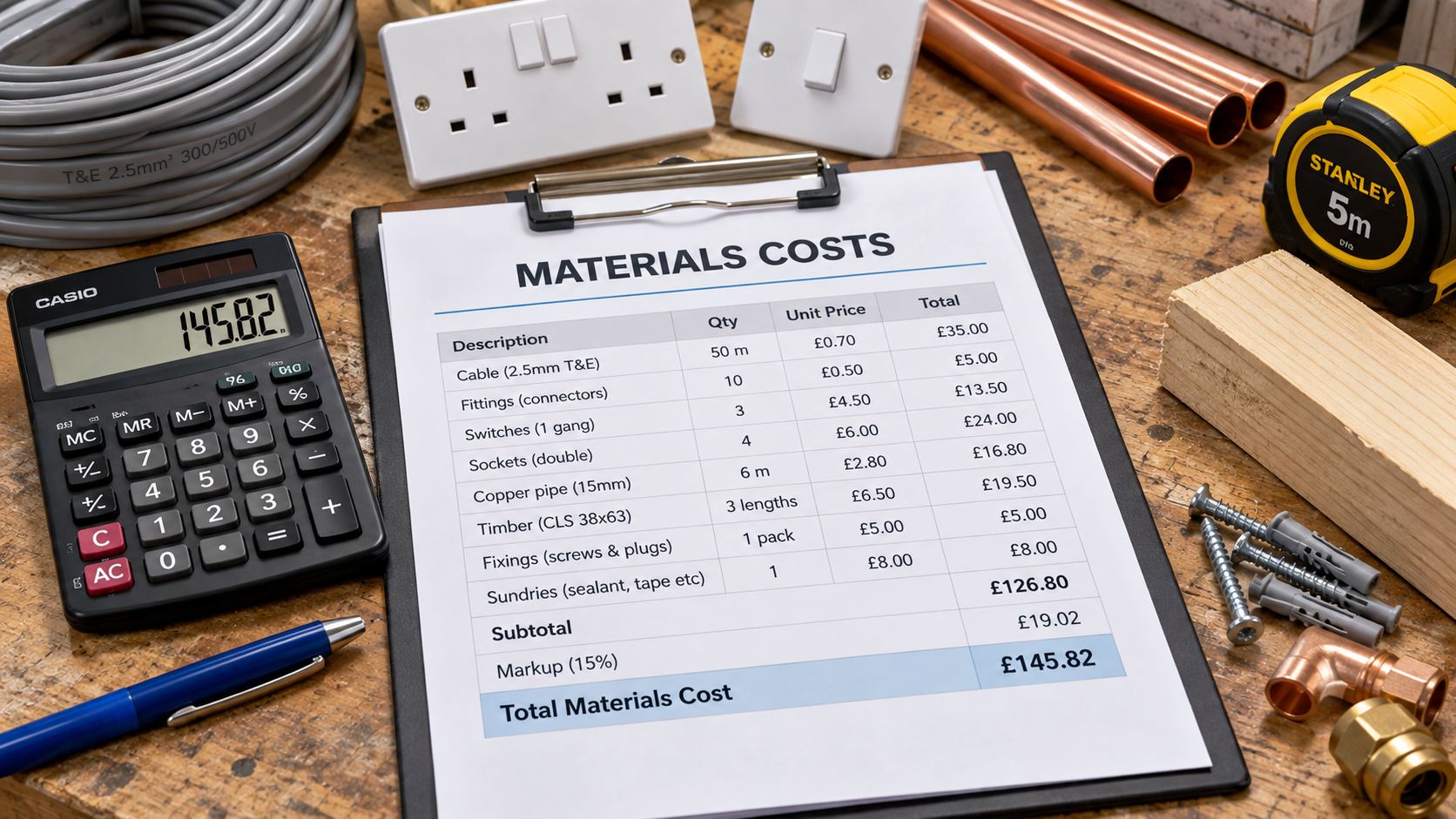
Pricing materials correctly means more than knowing what things cost. You have to allow for waste, round up to the sizes you can actually buy, include the small items nobody lists, protect yourself against price rises, and add a mark-up that genuinely makes you a profit. Miss any one of these and part of your profit disappears before the job starts.
Materials are one part of a complete price. For the full picture of labour, overheads, materials and profit, read our guide on how to price a job properly. This post deals with materials in detail.
Step 1: Do a proper take-off
A take-off is a list of every material the job needs, with quantities worked out from measurements. Don't estimate materials by eye or from memory. Measure, calculate and write it down.
Work through the job task by task, in the same order you'll do the work. If you've already broken the job down for your labour estimate, use the same task list for materials. Each task tells you what you need. That way, nothing gets forgotten, and your labour and materials figures match each other.
Step 2: Add a waste allowance
You never use exactly the quantity you calculate. Materials get cut, broken, damaged and spoiled. If your price is based on the exact measured quantity, you'll pay for the difference yourself.
Typical waste allowances are:
• Wall and floor tiles: around 10% for straight laying, 15% or more for diagonal or complex patterns
• Laminate and wood flooring: 5–10%, more for rooms with bays, alcoves or lots of doorways
• Plasterboard: around 10%
• Timber: 10–15%, depending on how many short cuts the job needs
Adjust these for the job in front of you. A small room with awkward shapes wastes a much higher proportion than a large, square one. Your own records from past jobs will tell you what your real waste rates are.
Step 3: Round up to pack sizes
Suppliers sell in boxes, packs, lengths and sheets, not in the exact quantity you need. Always price the number of packs you'll actually buy.
Here's an example. A tiling job measures 23m², and the tiles come in boxes covering 1.44m².
• Without waste: 23 ÷ 1.44 = 15.97, so 16 boxes
• With 10% waste: 23 × 1.1 = 25.3m², then 25.3 ÷ 1.44 = 17.57, so 18 boxes
Price 16 boxes and you're two boxes short. You either pay for them yourself or waste time making an extra trip to the merchant. That trip is unpaid labour too; see our guide on estimating labour times accurately for the other hidden time most quotes leave out.
Step 4: Include consumables and sundries
Screws, fixings, adhesive, sealant, filler, sandpaper, blades, drill bits, dust sheets, masking tape, cable clips and cleaning materials all cost money. None of them appears on a main materials list, and together they can easily add up to £50 or more on a medium-sized job.
There are two ways to cover them:
1. List them individually on larger jobs where the quantities are significant.
2. Add a fixed consumables allowance, typically a percentage of the main materials cost, on smaller jobs.
Either method works. What doesn't work is ignoring them.
Step 5: Price at today's cost, not last year's
Material prices change, sometimes quickly. If you price a job using what you paid three months ago, you may find the price has gone up by the time you buy.
To protect yourself:
• Check current prices with your supplier before you quote, especially on large or expensive items.
• Price at replacement cost. If you're using stock from the van, charge what it would cost to buy again today, not what you originally paid.
• State how long your quote is valid for (30 days is common) and make clear that material prices may be reviewed after that.
• On long jobs, or where prices are unstable, agree in writing how price increases will be handled before you start.
Also include delivery charges, and allow for any items with long lead times, which may need ordering well in advance.
Step 6: Understand mark-up and margin
This is where many tradespeople lose money without realising it. Mark-up and margin are not the same thing.
• Mark-up is the percentage you add to the cost.
• Margin is the percentage of the selling price that is profit.
Take £1,000 of materials with a 20% mark-up:
• Selling price: £1,000 + £200 = £1,200
• Profit: £200
• Margin: £200 ÷ £1,200 = 16.7%, not 20%
If you've told yourself you make 20% on materials, you actually make 16.7%. To get a genuine 20% margin, you need a 25% mark-up (£1,000 + £250 = £1,250, and £250 ÷ £1,250 = 20%).
The gap looks small on one job. Across a year's worth of materials, it can be thousands of pounds.
Step 7: Decide what your mark-up covers
Some tradespeople feel uncomfortable adding a mark-up to materials, as if they're overcharging the customer. They aren't. Your mark-up pays for real costs:
• Time spent choosing, ordering and collecting materials
• Checking deliveries and dealing with wrong or damaged items
• Storing materials and carrying stock in the van
• The risk of paying for materials before the customer pays you
• Returns, breakages and warranty call-backs involving faulty products
A mark-up between 10% and 25% is common, depending on your trade and the type of work. Choose a figure that covers these costs and leaves a profit, and apply it consistently.
Step 8: Handle customer-supplied materials carefully
Some customers want to buy their own materials to save money. You lose your mark-up and take on extra risk: wrong quantities, poor-quality products, late deliveries and disputes about faults.
If you agree to it, protect yourself:
• Make clear in writing that you're not responsible for the quality or suitability of materials you didn't supply.
• Charge for any time lost waiting for materials or dealing with problems they cause.
• Consider a slightly higher labour rate to make up for the lost mark-up.
The short version
Do a proper take-off. Add a realistic waste allowance. Round up to pack sizes. Include consumables. Price at today's cost and limit how long your quote stands. Know the difference between mark-up and margin, and use a mark-up that genuinely covers your costs and makes a profit.
Find out whether you're really making money on materials
Getting your materials price right is only half the job. You also need to know whether the job came in on budget, or whether extra boxes, return trips and price rises quietly ate your profit.
TradeProfit shows you. Add your materials when you create a job and your forecast profit appears straight away. When you finish, log the actual costs and see your real profit against your forecast, including labour, van, travel and labourer costs. It's free for your first 10 jobs, and no credit card is needed.
Know your real profit on every job.
Want to go further? The Complete Guide to Running a Profitable Trade Business has a full section on pricing materials, including waste, consumables and mark-up. Its free profit toolkit includes a Material Mark-Up Calculator and a Material Waste Allowance Table.